
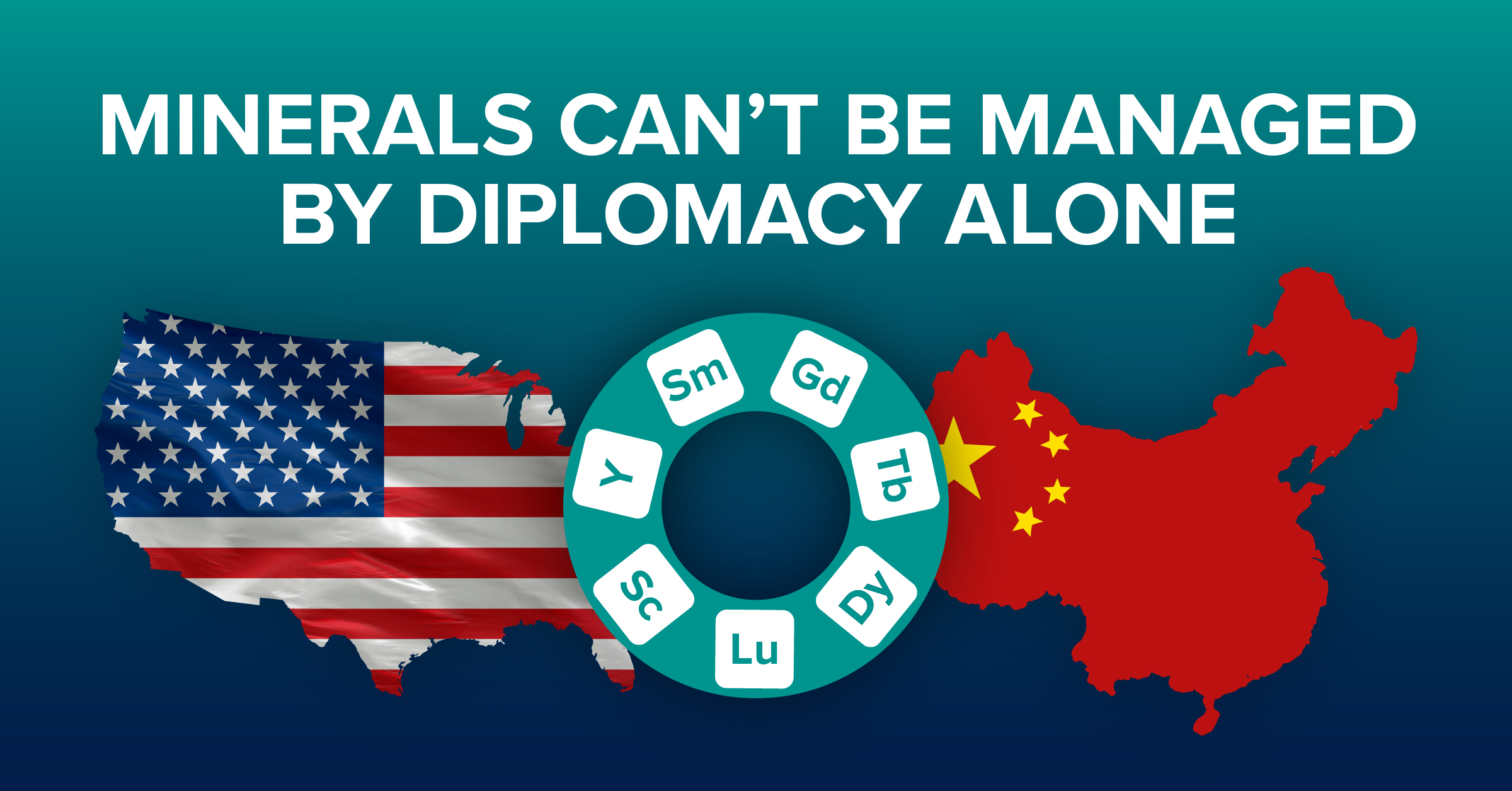
The recent face-to-face talks between President Trump and Chinese President Xi Jinping once again saw the world’s two largest economies trying to ease tensions over trade and minerals. Any progress that restores the flow of essential minerals and materials into global markets is welcome news for manufacturers, energy producers and defense contractors already dealing with tight supplies and rising costs.
But even with that progress, the United States cannot bet its economic future on the hope that Beijing will choose cooperation over leverage. Reuters reported this month that China’s export curbs on rare earth materials are still constraining global supply despite discussions about extending a temporary truce. Rare earth exports remain sharply lower, affecting industries from defense systems to advanced manufacturing. These challenges are another reminder that mineral supply chains are now instruments of geopolitical leverage, not simply commodities traded through global markets.
Why Minerals Matter to the American Economy
Mineral import challenges carry enormous consequences for the United States economy and our national security. Minerals are not a niche input. According to the U.S. Geological Survey, minerals industries contributed more than $4 trillion to the U.S. economy in 2025, while the value of U.S. nonfuel mineral production rose to $112 billion. Yet the same data show we remain 100 percent import reliant for 15 minerals and more than one-half import reliant for 46 non-fuel minerals. That is not just a supply chain concern. It is a direct economic vulnerability.
Minerals support nearly every modern industry. Copper, lithium, graphite, silver, rare earths and many other minerals are essential to electricity infrastructure, artificial intelligence, semiconductors, aerospace systems, vehicles, defense technologies and advanced manufacturing. Yet, the United States remains dangerously dependent on foreign sources – notably China – for many of them.
When supply disruptions occur, manufacturers face higher costs, delayed production and increased uncertainty. Defense supply chains become more exposed. Energy infrastructure projects become more expensive. Companies considering investments in advanced manufacturing or data infrastructure must account for growing supply risk in materials essential to their operations.
Mineral security should be treated as a long-term economic and national security strategic imperative rather than a short-term diplomatic exercise. Diplomacy surely matters. Stable trade relationships matter. Open communication between major economies matter. But our reliance on mineral supplies under Beijing’s thumb is untenable, regardless of a potential détente. This is a challenge we must solve. The answer, should we choose to forcefully pursue it, is fortunately largely here at home.
A Durable Strategy Requires Domestic Mining and Processing
The United States needs a durable strategy built around domestic production, processing capacity and supply chain resilience. America possesses abundant mineral resources, a highly skilled workforce and world-class mining expertise. Geology is not the barrier holding us back. It is whether our country is willing to develop the policies necessary to support long-term investment and turn our vast mineral potential into robust, secure production.
Doing so begins with permitting reform. It should not take a decade or longer to approve mining projects that are essential to economic security and national defense. Nor should it be so challenging to stand up domestic processing capacity, so minerals mined in North America are not sent overseas before returning to American manufacturers.
The debate has moved beyond whether minerals matter and toward what concrete steps are needed to secure reliable access. The next test is whether the United States will act with enough urgency to match the scale of the risk. America cannot negotiate its way out of mineral dependence one summit at a time. A stronger domestic mining and processing sector will not eliminate every supply risk or end the need for international partnerships. But it will give the United States greater economic stability, stronger industrial capacity and more strategic flexibility in an increasingly competitive world.
This is not just mining policy. It is economic policy, industrial policy and national security policy all at once.